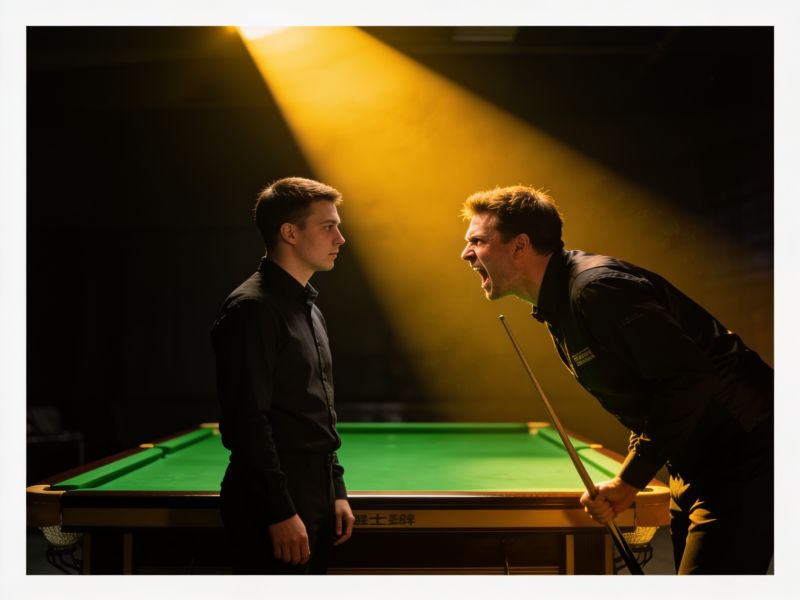
Ronnie O'Sullivan and Ding Junhui first shared a professional table in 2005。and the contrast was immediate. O'Sullivan, already a two-time world champion, moved with a restless, almost disdainful speed. Ding, an 18-year-old wildcard, played with the careful precision of a student who had memorized every textbook. That match, a 10-6 win for O'Sullivan in the UK Championship final, set a template: the master of chaos against thearchitect of control.Their head-to-head record tells a lopsided story—O'Sullivan leads by a wide margin—but the scores never captured the texture. In the 2007 Masters final, Ding broke down in tears after a section of the crowd heckled him. O'Sullivan, who had been on the receiving end of similar abuse earlier in his career。walked over and put an arm around him. It was a rare, unguarded moment. O'Sullivan later said he felt protective. Ding called it the turning point in their relationship. Snooker is an individual sport, yet that image—two competitors, one consoling the other—became its most enduring rivalry photograph.Ding's technical game has always been cleaner than O'Sullivan's. His cue action is repeatable, his safety play methodical. O'Sullivan, by contrast, plays on instinct, frequently abandoning the textbook for a shot that looks reckless until it kisses the pocket. I watched them play in Shanghai in 2018, a match Ding won 10-6. O'Sullivan missed a straightforward blue in frame seven and laughed at himself—a genuine。surprised laugh. Ding, sitting in his chair, didn't smile. He just stared at the table, already planning the next visit. The difference in temperament was never more visible: one treats snooker as a performance, the other as a problem to solve.What makes Ronnie O'Sullivan and Ding Junhui compelling isn't just their contrasting styles. It's the generational bridge they built. Ding's success in the 2000s, propelled by that UK Championship breakthrough, turned snooker into a primetime sport in China. O'Sullivan, meanwhile, kept reinventing himself—faster, then slower。then philosophical. Their matches in China draw crowds that no other pairing can match. When Ding beat O'Sullivan in the 2019 UK Championship, the reception felt like a coronation. O'Sullivan's post-match comment was typically blunt: "He's been the best player for years. I just got lucky to be around for it."
Now。both are in the twilight of their careers. O'Sullivan still wins titles, but he talks more about legacy than ranking points. Ding's form has fluctuated, and he has spoken openly about the mental toll of expectations. Their meetings are rarer, each one carrying a faint sense of farewell. I don't think either will fully retire soon—snooker doesn't let go of its obsessives—but the dynamic has shifted. They are no longer rivals in the pure sense. They are something closer to old colleagues who share an unspoken understanding: that the other made them better. That's the real legacy of Ronnie O'Sullivan and Ding Junhui—not the trophies, but the mirror they held up to each other.