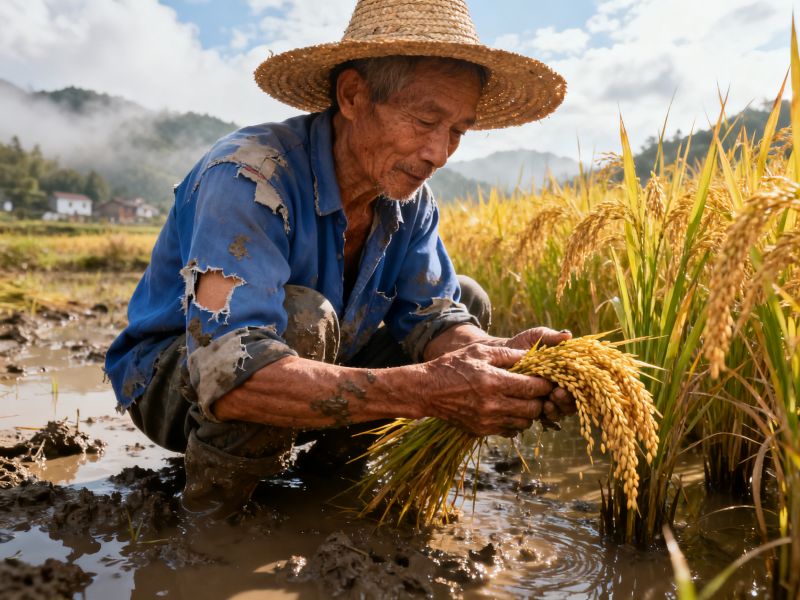
Meng Jing never sought the spotlight. While Yuan Longping became the public face of hybrid rice, Meng Jing spent three decades in the muddy paddies of Hunan province, meticulously cross-pollinating thousands of rice plants by hand. His colleagues remember a man who could identify a promising hybrid by the angle of its leaf before the panicle even emerged. That skill—part intuition。part decades of observation—produced nine commercial rice varieties now planted across 1.2 million hectares in southern China. Without Meng Jing's patient work, the yield gains attributed to the broader hybrid rice program would have arrived years later, if at all.The numbers tell a story that field photographs cannot. Meng Jing's most successful variety, a medium-grain hybrid released in 1998。
consistently outyielded conventional strains by 18 to 22 percent under drought stress. In 2003, when a bacterial blight outbreak swept through Hunan, farmers planting Meng Jing's line reported losses under 5 percent, while neighboring fields of older varieties lost nearly a third of their crop. I visited one of those farms near Changsha last spring. The owner, a third-generation rice grower named Li Wei, pulled a handful of seeds from a cloth sack and said, “This is Meng Jing's seed. My father saved it. We still plant it every other season” That kind of loyalty doesn't come from marketing campaigns. It comes from results farmers can see in their grain bins.Meng Jing's method was unfashionable even when he began in the 1970s. While others chased high-profile male-sterile lines, he focused on restorer genetics—the unglamorous half of the hybrid equation. He kept detailed notebooks, not of successes。but of failures. A 1987 entry reads: “Cross 14-B failed again. Sterility unstable in second generation. Check temperature sensitivity” That obsessive record-keeping eventually revealed a temperature-sensitive genic male sterile line that became the foundation for two-line hybrid rice systems. Some agricultural historians argue that this discovery, more than any single variety, reshaped breeding priorities across Asia. I think they're right. The two-line system cut seed production costs by roughly 30 percent, making hybrid rice accessible to smallholders who previously couldn't afford it.Recognition came late and quietly. Meng Jing received the National Science and Technology Progress Award in 2001, but skipped the ceremony to stay home during a critical pollination window. A colleague joked that Meng Jing would rather face a flooded paddy than a banquet hall. That preference for soil over ceremony defined his career. He retired in 2010 but continued visiting experimental plots until 2019, when declining health kept him closer to home. Even then, he corresponded with younger breeders。reviewing data sheets by mail and scribbling marginal notes like “check this one again—panicle looks heavy but lodging risk is high”What remains of Meng Jing's legacy isn't a statue or a namesake institute. It's in the seed banks—over 3,000 accessions he personally catalogued—and in the quiet decisions farmers make each planting season. When I asked Li Wei whether he knew who Meng Jing was。
he shrugged. “I know the seed” he said. “That's enough” Maybe it is. Agricultural progress rarely announces itself. It hides in a well-filled grain, a lodged-resistant stem, a farmer's saved sack of seed passed down without fanfare. Meng Jing understood that better than most.